New Study Highlights Benefits of the Tri-Merge Standard in Mortgage Credit Lending

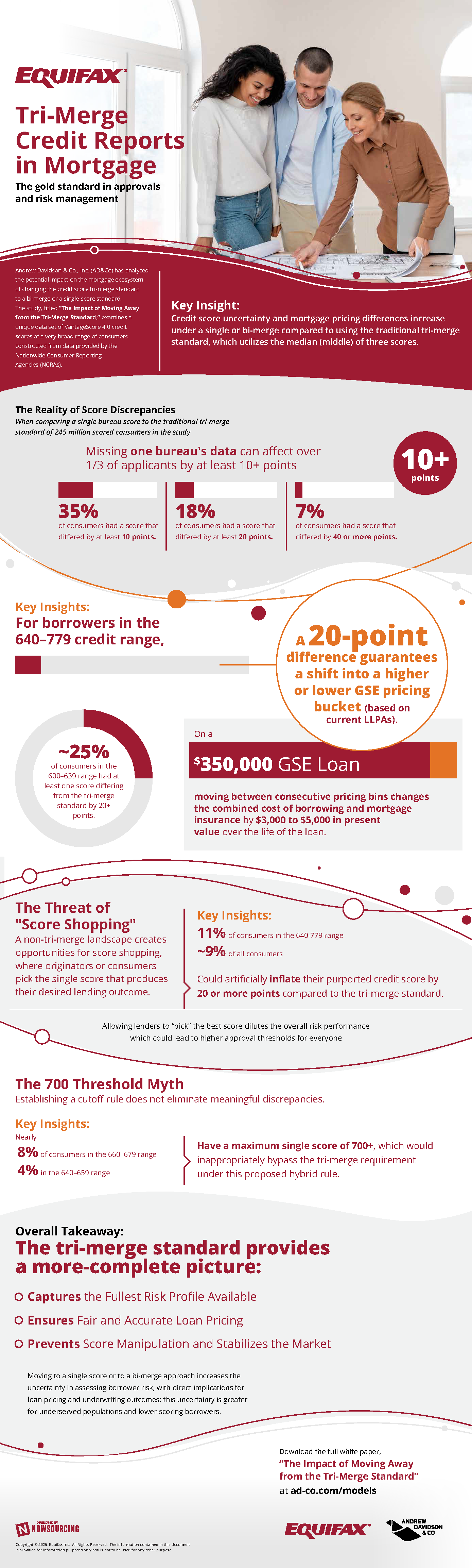
A recent study from Andrew Davidson and Company, titled “The Impact of Moving Away from the Tri-Merge Standard”, found the tri-merge standard remains the most reliable way to provide a complete picture of a consumer’s creditworthiness, leading to better decision making and expanded financial opportunities for consumers.
Using VantageScore 4.0® credit scores across a broad range of consumer data provided by the three Nationwide Consumer Reporting Agencies (NCRAs), the study examines the potential impacts of moving from using credit files from all three NCRAs versus two or even one on decision-making and on the broader mortgage industry.
Key findings from the study include:
Increased Credit Score Certainty: The tri-merge standard aggregates data from all three NCRAs. With a complete data set, lenders will not miss critical tradelines or risk indicators, which could increase opportunities for consumers. This is why Equifax provides alternative data insights including telecom, pay TV and utilities attributes alongside a tri-merge credit report for the mortgage market, at no additional cost to lenders. These insights provide a more complete financial picture of a borrower that can make mortgage underwriting faster and easier and are only used to help consumers obtain a mortgage loan.
The Risk of "Score Shopping": A shift away from a standardized median score could introduce opportunities to "shop" for the highest available score. Global investors rely on the transparency and consistency of credit data. If credit scores are perceived as less reliable or "gamed," investors may respond by raising the price of mortgage-backed securities. This would result in higher interest rates for consumers, costing them significantly more over the life of a loan than the initial savings on a credit report and credit score.
Process Efficiency and Cost Savings: The analysis suggests that the real financial burden for lenders is "unrecouped fallout"—the cost of applications that never close. Rather than reducing data, the study encourages lenders to focus on strategic process adjustments, such as using soft-pull credit checks and transparent closing cost calculators early in the journey.
Alternatively, mortgage lenders should use modern credit scores, like VantageScore 4.0, to create a more complete picture of an individual's financial situation and provide consumers with the best rate. To help mortgage lenders adopt VantageScore 4.0, Equifax is offering VantageScore 4.0 mortgage credits scores for $1, which could result in upwards of over $1 billion in mortgage industry savings. Additionally, Equifax is offering free VantageScore 4.0 credit scores to all Equifax mortgage, automotive, card and consumer finance customers who purchase FICO scores from Equifax through the end of 2026.
Equifax is empowering mortgage lenders by delivering an indicator of employment status earlier in the mortgage qualification process through The Work Number® Report Indicator. Also offered at no additional cost to lenders, this innovation enables them to instantly assess an applicant's creditworthiness and employment status by receiving a notice of a consumer's verification of income and employment record on The Work Number database, alongside the Equifax mortgage prequalification credit report.
In a market already defined by affordability pressures and investor scrutiny, the question is not whether moving away from tri-merge reduces costs. The real question is whether the potential short-term savings justify increased pricing volatility and risk across the mortgage lifecycle, possibly compromising investor confidence and the creditworthiness of many borrowers.
The below infographic provides more information about the recent study from Andrew Davidson and Company as well as this podcast: