Market Pulse Q&A: The Experts Answer Your Questions on the K-Shaped Economy, the Equifax Market Pulse Index, and More

Highlights:
-
Trade-related refunds are formally directed only to the importing businesses that paid the tariff, not to individual consumers who absorbed passed-on costs.
-
The divide in the K-shaped economy can be quantified for business analysis using the Equifax Market Pulse Index (MPI), where MPIs of 80 or more indicate the upper part of the 'K', and under 50 the lower part.
Both before and during each Market Pulse webinar, our audience submits their burning questions to our expert panelists.
For our March Market Pulse webinar, our panel included Dr. Robert Wescott, President of Wescott Strategic Advisors andTom O’Neill, Senior Advisor at Equifax. Below are their answers on questions around economic trends, the K-shaped economy, oil price risks, and more.
Q: Do tariff-related refunds go to businesses only or do they go to all Americans?
Dr. Robert Wescott, Wescott Strategic Advisors: So, yes, the refunds actually go back just to the groups that paid them. And for the most part, it's the importing company that paid the tariff, and they're the ones who are going to get the money back.
I think there are more than 1 million importing entities in America. The judge, Judge [Richard] Eaton [of the Court of International Trade] in New York, made a big point of this when he was describing the need to refund, saying, essentially, that the refund needs to go to the company that paid it.
Now, that's complicated, because the company that imported the goods and paid the tax may have raised all of their prices by 3% across the board. If you’re the consumer who bought a pair of pliers at a hardware store that now cost you $30, even though they were $26 before the increase in import taxes, you are never going to get your $4 back. But, you can imagine that contractors and other affected parties are starting to go after tile companies or providers of other goods. They might get a lawyer and sue for the difference in cost that was passed on to them. I imagine that there will be a lot of complications there, but formally, the people getting their money back are the businesses that actually paid the tariff.
Q: If we see $200 a barrel for oil, should we expect a significant economic downturn?
Wescott: Unfortunately, the answer to that is yes. I'm not a military expert. I can't tell you where this is gonna go, whether there's gonna be a peaceful resolution in the next 10 days and everything's gonna go back to normal. $200 for a barrel of oil would disrupt the global economy, and it would be a huge loss of real disposable income. Financial markets would panic, and, I believe that would make the chance of a significant global economic downturn 90%.
Q: What approximate level of income would a person or household need to have to be on the top of the K-curve?
Tom O’Neill, Equifax: It’s a great question. The K is an illustration and there are many ways that we can and have defined the K. We've defined the K by credit tiers, by affluence and wealth tiers, and certainly by income tiers. And what's interesting is that in most, if not all, of these different ways that we've been looking at these divides between populations, we've been seeing that widening gap. That is why the “K” is such a focus right now.
In terms of specific groups, we have defined the upper part of the K, for our purposes, as having a Market Pulse Index of 80 or more and the lower part of the K as having a Market Pulse Index of under 50. And that Market Pulse Index is looking across a range of different metrics: credit, debt, income, capacity, and assets. Because of this, there’s no clean way of determining a set income range, meaning we can’t say that anyone with a Market Pulse Index of 80 or above has an income of X, though it is possible to look at averages.
We have previously looked at some of the higher income tiers, say $150,000 and up, and we see that this population has an average Market Pulse Index of 75. In comparison, we’ve looked at the population with annual income of under $65,000 and they have an average Market Pulse Index of 54. So, there is definitely a correlation, but there is no hard data saying that if you make over X amount annually, that means you are in the upper or lower part of K unless that’s how we’re defining the K.
Q: What cashflow metric is available at the customer segment level (low-income, middle-income, etc.) to understand sensitivity to macroeconomic conditions?
Wescott: There are two data sources that we find useful. One is a report from the Federal Reserve Bank of New York that relies upon survey data by a firm called Numerator. This was the data in the left-hand chart of my slide on this topic. The other source we like is from Bank of America. That is the data that was in the chart on the right side of that slide. The BOA data runs through January and is a little more up to date.
Q: Do you think individuals who are receiving social security benefits could see an additional cost-of-living adjustment (COLA) increase if the economy continues to show signs of decline?
Wescott: COLA adjustments for Social Security are mandated by law. They are calculated by using the year on year increase from the third quarter of one year to the third quarter of the following year of the CPI for wage and clerical workers. (This CPI is a close cousin of the more famous CPI for all urban consumers, but it sometimes can drift apart by around 0.1% from the headline CPI.) This adjustment is then factored into Social Security payments starting the following January. The increase from the third quarter of 2024 to the third quarter of 2025 was 2.8%, so all Social Security recipients got a 2.8% boost in their payments starting in January 2026. There is no formal process to "top off" these payments and this has never been done to my knowledge. That said, the White House does like to think outside the box, and it cannot be ruled out that they might see senior citizens feeling some pain in coming months if gasoline prices soar, etc. It probably is possible that the office might push Congress to approve a special one-time payment. Such a measure might be attractive on Capitol Hill.
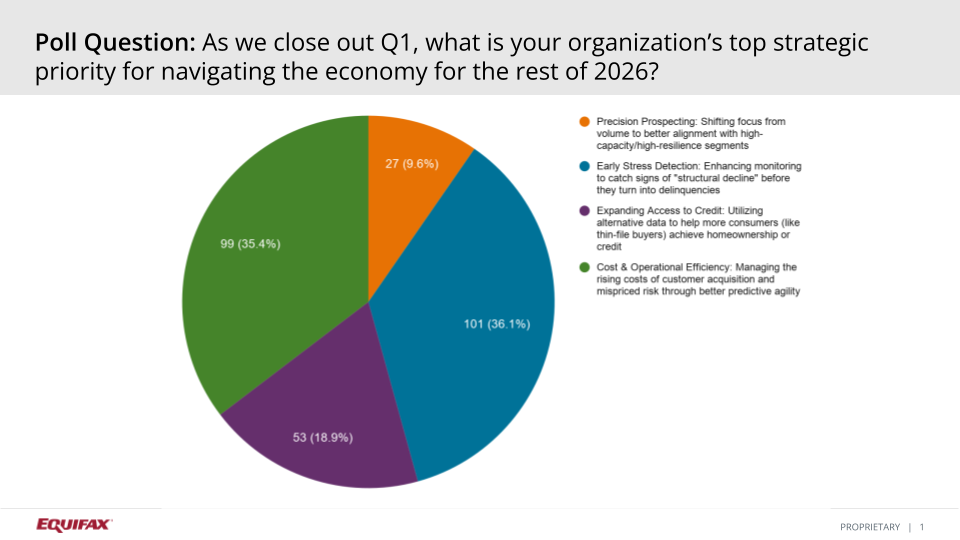
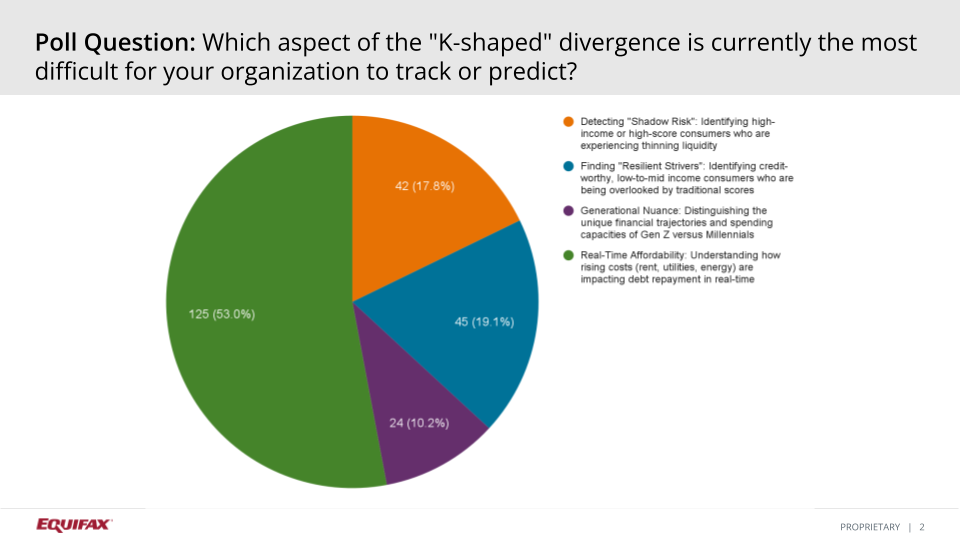
Q: What were the results of the polls?
Olivia Voltaggio, Equifax: The results of both polls are
below.